%20(1)_edited.png)
Why Serious Events in Thailand Start With a Proper Enquiry — Not a WhatsApp Message
Updated: Jan 20
If you are searching for reliable event planning in Thailand, or thinking about a destination wedding in Thailand, a luxury private party, or corporate events in Thailand, please read this first. We built our enquiry system because the difference between a memorable event and a costly mistake is not always talent or budget — it is the way the project begins. Start correctly and you protect time, money, culture, and reputation. Start casually and you risk all of them.

A Quiet Truth About High-Budget Events in Thailand
Thailand is one of the most alluring places on earth to celebrate: the light, the hospitality, the venues, the food, the craft. It is also one of the most complex places to deliver large, high-expectation projects because the local ecosystem is fragmented and high-touch. Many people assume that organizing a large event or a destination wedding in Thailand simply means finding a beautiful venue and booking vendors. That assumption is the root cause of most failures.
When budgets are high, stakes are high. Guests travel, reputations are visible, and cultural nuances can turn a great idea into a mistake if they are not managed with sensitivity. A quick WhatsApp exchange may feel efficient, but it rarely carries the strategic clarity an A–Z, accountable planning team needs to protect the outcome. That is why a proper enquiry — structured, honest, and considered — is the first act of responsible planning.

Why This Article Exists (And Why Few People Say It Out Loud)
Most event websites show pretty galleries and success stories. Few publish the part of the job that matters first: the intake and evaluation process. Why? Because explaining process disqualifies some enquiries. It asks questions. It creates friction. For many businesses, that friction is commercially inconvenient.
We believe the opposite. Transparency at the beginning protects everyone: the client, the team, the suppliers, and the guests. We want to change the default behaviour for high-budget events in Thailand. If you read this and adopt a more rigorous first step — even if you never use our services — your event will benefit.

Event Planning vs. Vendor Coordination: The Fundamental Misunderstanding
People use the words “event planning” and “vendor booking” interchangeably. They are not the same.
Vendor coordination is transactional: you hire suppliers and hope they align.
Event planning is strategic: you design a sequence of decisions, manage tradeoffs, and create one accountable flow from idea to execution.
Packages and one-size offers are convenient, but they rarely protect complex projects. For high-value events, you cannot reverse engineer the guest experience from a single checklist. Planning is the invisible work: risk mapping, contingency planning, cultural consultation, guest logistics, legal and permitting oversight, and more. When that layer is absent, the visible components fall apart.

The Moment Everything Goes Wrong: First Contact
The vast majority of mistakes we manage as planners can be traced back to the first conversation. When a project begins with casual chat messages and screenshots, there is no documented baseline. No one has clarified decision makers, no one has recorded the real scope, and assumptions multiply. A vendor will interpret the message in the way that benefits them; a planner will assume context that may be wrong.
Starting structurally — with an enquiry that asks for budget range, dates, number of guests, cultural needs, and decision timeline — is not about control; it is about creating an honest baseline for everyone. It reduces ambiguity, aligns expectations, and gives both sides the respect of clarity.

Why a Proper Enquiry Is Strategic — Not Bureaucratic
A well-constructed enquiry is the planning team’s first design tool. It tells us:
If we are the right team for the job
What level of creative energy and resources are required
Which division should lead (wedding, VIP, party, corporate)
What cultural or legal sensitivities apply
Whether the timeline and budget are realistic for the brief
Treat those early questions like strategy, not paperwork. They allow creativity to occur within safe bounds. They help the planner design a solution that is realistic and inspiring rather than a fantasy that collapses during implementation.

The Missing Layer in Thailand: Accountability Architecture
Thailand has exceptional suppliers: venues, chefs, artists, decorators. The missing layer is often accountability architecture — a single team that coordinates across all suppliers, local authorities, and guest needs, and takes responsibility for the whole journey.
When there is no accountable team:
Responsibility diffuses
Costs creep unpredictably
Cultural and regulatory missteps happen
Guest flow and transport often become afterthoughts
A proper enquiry helps assign accountability early. It gives the planner permission to negotiate, to lock down logistics, and to create a single source of truth for decisions and contracts.

Why One Form Is Never Enough
We don’t use a single intake form for everything because not every celebration starts the same way. A destination wedding has different risks and cultural needs than a multi-day corporate summit. A VIP private program may require security, NDAs, and private arrival logistics. Treating them the same is a professional shortcut that often leads to failure.
Different enquiry paths help ensure:
The right team sees the right projects
Sensitive enquiries are handled discreetly
Technical requirements (permits, aircraft, maritime) are captured early
Commercial expectations are set before creative work begins
This is why we created multiple, focused enquiry paths. They are not branding; they are operational intelligence.

The Five Enquiry Paths: Why Each Exists and What They Capture
Below we explain, without sales language, why each enquiry path brings meaningful signal and how it shapes the planning process.

Unified Event Enquiry — a safe starting point
For those who know they need help but don’t yet know the structure. This path captures wide intent, allows us to triage effectively, and is ideal for early-stage clients who want professional direction without immediately picking a division.
What it captures: broad scope, budget range, dates, guest mix, rough priorities. Why it matters: it prevents premature specialization and routes the project to the right team.

VIP & High-Complexity Enquiries — security, discretion, scale
For ultra-private, high-risk, high-visibility programs: multi-city logistics, private aviation, close protection, and guest handling at the highest level. These enquiries trigger a different operational review.
What it captures: confidentiality needs, security concerns, scale, and special transport. Why it matters: VIP logistics are specialized; missteps cost far more than money — they cost trust and reputation.

Party & Private Celebration Enquiries — multi-event journeys
Luxury private parties are often not single-evening affairs. They can be 2–5 day journeys across villas, yachts, and island venues. These require program scheduling and guest travel coordination beyond the creative brief.
What it captures: program structure, multi-day preferences, transport, day-to-day guest flows. Why it matters: great parties are journeys; treating them as single events wastes opportunity and risks disruptions.

Wedding Enquiries — heritage, family, ceremony
Weddings demand cultural literacy and family coordination. They require early conversations about legalities, rituals, guest sensitivities, and symbolic priorities.
What it captures: family structure, cultural rituals, religious requirements, multi-day sequencing. Why it matters: weddings are cultural contracts; a planner who ignores family dynamics or symbolic accuracy causes harm, not just inconvenience.
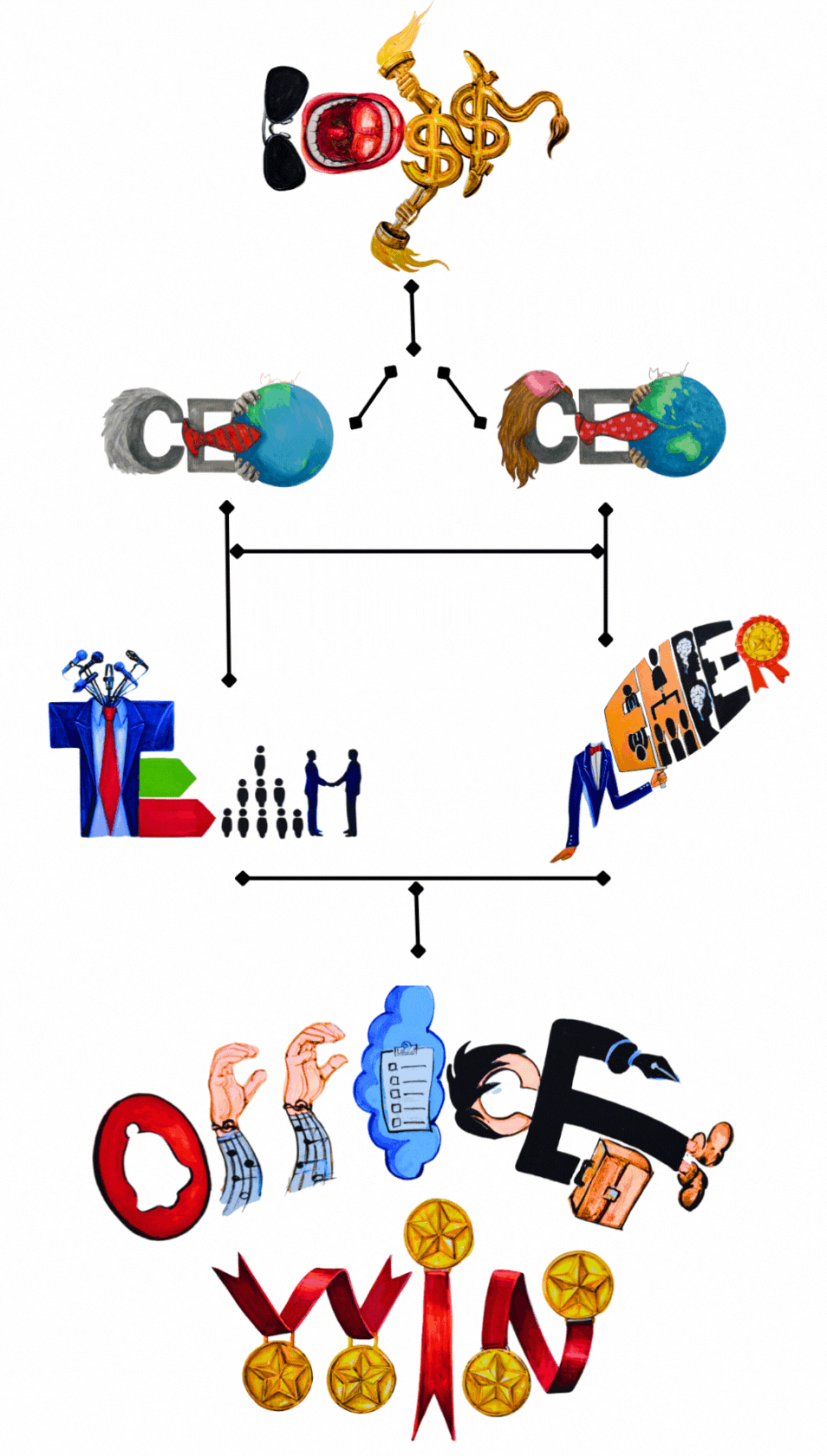
Business, Corporate & MICE Enquiries — governance and reputation
Corporate programs have different objectives: brand messaging, stakeholder management, procurement rules, and sometimes legal reporting. Planning these requires disciplined timelines, risk matrices, and procurement transparency.
What it captures: governance, procurement needs, speaker logistics, corporate branding requests. Why it matters: corporate failures are reputational and contractual; they require a different planning methodology.

What Happens After You Submit an Enquiry — the Honest Version
We do not automate the first review. Every enquiry is read by a human — our team matches scope, dates, and budget to our available divisions and resources. The possible outcomes are:
Accepted for follow-up — we invite a consult and outline the next steps.
Advised — we provide practical suggestions or refer to a more suitable partner.
Declined respectfully — we explain why we are not the right fit.
This process is about mutual fit. Saying no is not failure; it is an ethical decision that protects the client and the studio’s standards.

Free Consultation — What It Is and What It Is Not
“Free consultation” does not mean “free design.” A consultation is a professional evaluation. It includes:
A review of the enquiry and documents
A candid alignment conversation about priorities and feasibility
High-level suggestions about scope and sequencing
It does not include a full creative concept, detailed budgets, or site surveys. Those are scoped and priced because they require real resources and an accountable team.

Budget Truths Everyone Should Know
Budget is rarely a number alone. It is an ecosystem of decisions.
A higher budget requires more governance and often a longer planning window.
A larger guest list requires more contingency and transport planning.
Some items scale poorly; others scale well. Understanding which is which is experienced work.
We work on a transparent percentage model because it aligns incentives: as your program scales, our percentage may reduce, and more of your budget goes into the guest experience rather than margins hidden in vendor costs.
Transparency is not easy. It is essential.

Why This Matters Even If You Use Another Planner
We want this to be useful beyond our doors. If you never hire us, you can still use this document to:
Ask better questions
Spot red flags in proposals
Protect your budget and your guests
Avoid common, preventable mistakes
That knowledge is valuable whether you choose our team or any other.

The Real Cost of “Saving Time”
Choosing the seemingly fastest route — a click, a DM, a small deposit — is often the most expensive decision. The real cost of haste is:
Rework and repair, which is always more expensive than planning
Reputational repair in social and business circles
Lost guest experiences that cannot be reclaimed
There are occasions when fast decisions are necessary. For high-budget, high-visibility events, speed should be tactical, not accidental.

Planning as Authorship, Not Assembly
We do not “assemble” events; we author them. An authored event reads like a carefully edited book; every chapter matters. That level of authorship requires research, listening, careful edits, and the discipline of a production process. A good enquiry starts that authorship.

Practical Questions You Should Ask Any Planner in Thailand (Short Checklist)
When you speak to a planner, ask:
What is your intake process? (You want a structured approach.)
Who will be onsite and what is their experience with local vendors?
How do you handle procurement and negotiations?
What is included in your fee and what isn’t?
How do you approach cultural research and family dynamics?
How do you manage guest logistics and transport?
What are your contingency plans?
Answers to these questions reveal whether a planner is thinking systematically or improvising.

Red Flags to Watch For
No clear intake process (only “DM us” or “send us screenshots”)
No documented budget conversation
Heavy reliance on correlational language: “we always use the same supplier”
Unwillingness to discuss risk, permits, or guest logistics
Vague or evasive answers about fees and margins
If you see these, slow down.

What We Do Differently — A Short Plain List
Human review of every enquiry
Segmented intake paths to the right division
A single accountable team, not a set of disconnected contractors
Transparent fee structures and visible supplier costs
Cultural consultation and family engagement when needed
Full logistic and contingency planning for guests and travel
We say this plainly because those practices are uncommon, but they are fundamental.

Case Example: Why Intake Mattered
We once received an enquiry for a multi-day program that began as “just a birthday dinner.” The intake revealed a multi-national guest list, VIPs arriving on private aircraft, and strict privacy requirements. Because the intake captured those signals, we transitioned the project into a private program, coordinated arrivals and departures, secured private transport, and designed multiple safe spaces for guests. Without the intake, the event would have been scheduled as a single dinner — and would have failed the moment guests arrived.
Siam Planner Co., Ltd. (ThailandPlanner.com) — Our Event Planning Philosophy
At Siam Planner Co., Ltd. and ThailandPlanner.com we do things differently because we believe the job of an event planner is not to re-sell a prettier catalogue item. It is to invent, protect and author profound experiences. Our philosophy is practical, creative, and uncompromising: creativity must be married to operations; artistry must sit beside procurement; imagination must be accountable to timelines and guest welfare. Below we describe what that actually means — not as marketing copy, but as a blueprint we live by every day.

Event planning philosophy Thailand — creativity must be disciplined
Great creative ideas are useless without disciplined execution. Too many event teams treat creativity as decoration: a pretty centerpiece here, a trending lighting treatment there. Creativity in our philosophy is structural. It is the way we conceive guest flow, the way we sequence emotions across a multi-day program, the way we use a ceremony to reframe a family narrative. When we say “creative event design,” we mean a design that can actually be produced on time, within budget, and in the real physical world where weather, customs rules, and guest mobility matter.
This means every creative concept we develop starts with constraints: the climate of the island, acoustic realities, guest age ranges, cultural sensitivities, transport timelines, and technical feasibility. Constraints are not obstacles — they are the frame inside which great design becomes original and meaningful.

Creative event design — original art, not templated copying
Most event websites show the same staged photos and the same designer presets. We reject that. Our art is original. We commission hand-painted works, bespoke decor and custom soundtracks. When a client sees our site and hears our company music, they should understand two things: first, we design from a place of unique authorship; second, we back that authorship with production standards that make those ideas real.
When a client asks for décor, we do not hand them a catalog. We study their story. We look at family histories, first meetings, and small personal objects — because those details inform color palettes, textures, and tactile moments that resonate with real guests. Our design direction is therefore not a “look” to copy but an authored interpretation of a couple’s story or a host’s personality.

Management skill and production management Thailand — logistics are creative instruments
Management skill is not just scheduling; it is creative instrumentality. We manage suppliers not to micro-control them, but to ensure each vendor’s excellence contributes to a single, coherent outcome. Production management here includes technical direction, run-sheet authorship, showcalling, stagecraft and contingency maps for every major decision.
We use production plans as creative tools. Lighting charts, sound plots, and AV integrations are not afterthoughts; they are how the creative narrative breathes at night. A spectacular idea that cannot be lit or cannot be heard is an idea that fails. Our emphasis on production management is what lets our creative ideas land in a way that guests remember.

Venue selection Thailand — research, not catalog choices
When a client asks “which venue is best,” our first step is not to show an inventory. Our first step is to ask layered questions: what is the emotional climax of the event? Do you want silence after the ceremony or a seamless transition to celebration? Should the sunset be the visual finale or a quiet backdrop? Is this a guest journey of privacy or visibility? Only after those questions do we start hunting venues with an eye for the right micro-conditions — sight lines, wind profiles, noise restrictions, sunrise and sunset angles, local permissions and neighborhood dynamics.
We choose places because they serve the story, not because they are fashionable. That often means discovering a tucked cliff, a small heritage house, or a particular lawn orientation that complements the concept. Venue hunting without this research is shopping; with research it is curatorship.

Cultural research for weddings — authenticity over appropriation
Weddings are not events; they are cultural promises. When a couple invites us to design a wedding that references a culture — their own or their guests’ — we begin with research. That does not mean copying an Instagram image; it means consulting with cultural practitioners, local elders, musicians, or academics where needed. We approach rituals the way historians approach primary sources — with respect, context and attention to meaning.
This cultural research ensures authenticity and reduces the risk of superficial appropriation. It also allows us to interpret rituals for modern contexts and to coordinate logistics and permissions when sacred spaces are involved. Cultural research keeps the wedding meaningful and truthful.

Guest profiling and hospitality planning — we plan for people, not personas
When a client provides a guest list, we parse more than names and meal choices. We profile travel patterns, mobility needs, VIP timelines, language requirements, dietary laws, and emotional context. Guests are human systems; a great event is the management of those systems in a way that reduces friction and amplifies joy.
We plan guest experience like product journeys. Arrival choreography, welcome rituals, quiet spaces for elders, charging stations for presenters, pre-dinner transitional music for guests to gather — these are small orchestral parts we manage because they determine whether the event feels luxurious or merely well-appointed.

Procurement negotiation and budget stewardship — transparency and value
We are obsessive about budget stewardship. Transparency is not marketing language for us; it is an operational rule. We do not mark up suppliers secretly; we work with clear procurement agreements and visible supplier costs. Our fee model is percentage-based because it aligns our interests with the success of your program: the better we optimize the budget, the better the outcome for the guests and the client.
This also means we educate clients on where money is best spent and where deflation yields no benefit. A luxury table arrangement may be less impactful than a truly exceptional chef, depending on the program. We balance spend to maximize perceived value: spending where guests feel it and saving where it is invisible.

Team accountability — a single team, one voice
In many projects the client meets dozens of vendors and many of those vendors provide contradictory advice. Our model is to create a single accountable team that speaks with one voice. That team includes creative directors, operations producers, vendor leads, and client liaisons. They meet to align decisions, and the client receives a single decision log rather than conflicting notes.
Accountability means ownership: if a timeline changes at 2 a.m. we know who will resolve it, who owns the communications, and how contingency resources are allocated. This one-team approach eliminates the blame layer and replaces it with action.

Production rehearsals and technical discipline — we rehearse the night before the live moment
We rehearse as if we are directing theater. Our run sheets are living documents with contingency branches for weather, travel delay, and VIP changes. Rehearsal is where timing, lighting decisions and performer cues are finalized. In our experience, events that allocate time for technical rehearsal are significantly more likely to achieve the intended emotional arc.
We do not believe in improvisational “charm” at the cost of guest safety or program coherence. Improvisation should be a creative option, not a fallback for poor planning.

Original artistry vs stock imagery — authenticity in every detail
Most event websites are visually interchangeable because they use the same stock images and repeat the same trends. We avoid that. Our visuals, calligraphy, music and art are crafted for each project. When a client lands on ThailandPlanner.com and hears the music we commissioned, it is a proof point: we invest in original human talent and production. That artistry becomes part of the event DNA.
This practice extends to how we use imagery for ourselves: we commission in-house art and original photography, not curated catalogs. The result is that our projects feel singular, not templated.

Music, sound design and original compositions — the emotional architecture
Sound builds memory. Our team includes composers and sound designers who write bespoke pieces for ceremonies or key program moments. Music is not background filler for us. It is architecture: entrance music that establishes tone, interlude pieces that change tempo, recorded material that frames transitions. A bespoke soundtrack can make a ceremony feel intimate or a celebration feel epic — music is a core design choice.

Crisis planning and contingency mapping — calm under pressure
Good planners are calm. Great planners are prepared. We build contingencies not as afterthoughts but as primary design elements: rain plans, transport backups, medical response plans, supply redundancy and communication trees. These contingency maps are rehearsed mentally and sometimes physically. The difference between a recovered disruption and a ruined night is often 30 minutes and the right decision tree.

Ethics, privacy and security — a non-negotiable standard for VIP work
For VIP programs, privacy and ethics are the baseline. We handle NDAs, confidential itineraries, and sensitive guest lists with procedures designed to minimize leak points. Security planning is coordinated with local authorities and private teams when needed. Ethics also include vendor vetting: we do not contract services that exploit workers or break local regulations.

Cultural humility and listening — the planner as an anthropologist
We practice cultural humility. That means listening before proposing, consulting before quoting, and integrating cultural advisors where necessary. It means understanding that a family’s rituals are not props to be dressed up. They are living practices to be honored. This humility gives our work depth and reduces the social risk that so many events inadvertently create.

Education and mentorship — growing a better industry
We believe the industry improves when knowledge is shared. We host workshops for local teams, mentor suppliers in production standards, and run post-event debriefs that quantify successes and improvements. When the industry is raised, clients win and creative opportunities expand.

Why originality endures and imitation fades — artistic truth
Artists who innovate create reference points that others follow. When a style becomes a template, it loses its power. The same principle applies in event design. Original concepts that are deeply rooted in story and context create lasting memory; copied trends flatten over time. We invest in originality because it is how legends in any creative field are created — painters, composers, filmmakers, and yes, planners. That is why we treat each brief as an opportunity to invent rather than replicate.

Measuring success — qualitative metrics and guest experience
We measure success in human terms: guest surprise, emotional flow, returns in goodwill, ease of logistics, and the absence of friction. We combine qualitative feedback with operational KPIs: schedule adherence, incident counts, vendor performance, and budget variance. This combination ensures the memory of the event is positive and leadership reading the post-event report is confident.

Post-event stewardship — how experiences become legacies
Our relationship rarely ends the night the lights come down. We produce post-event reports, return key items to clients, and follow through on contractual obligations. We advise on storytelling and archives — how to present videos and photos to family and clients in a way that supplements the memory rather than commodifies it. Events can be legacies; we manage them that way.

The disrespect of pretending to be unique — why forms matter
Many websites claim uniqueness but offer no structure. That is disrespectful. You cannot claim to produce original, culturally-accurate work without asking for the basic details that make that work possible. A reliable intake process is part of professionalism. Forms are not red tape; they are a promise that the project will be treated with the attention it deserves.

Closing the loop — authorship, accountability and long-term relationships
A planner must be a mastermind, not a matchmaker. We design the journey, select the talent, manage suppliers, and take responsibility for the whole. This requires curiosity, discipline, negotiation skill, creative courage and a willingness to say “this is not the right fit” when necessary. When those elements combine, a project becomes a singular authored work. That is what we aim for, and it is what we believe a high-end client deserves.

Start Properly, Protect Everything
If you are traveling to Thailand with a meaningful reason to celebrate or with many guests, the smartest decision is to begin properly. A properly structured enquiry is not a barrier. It is a safeguard. It is the best insurance you can buy before any contract is signed or any deposit is made.
We wrote this because we believe the industry needs it: more clarity, less sloppy communication, and a greater sense of responsibility from the very first conversation. If you choose to begin that conversation, do it the right way. It saves time, money, and most importantly — it preserves the intention of your celebration.

All artwork displayed throughout this article — including alphabet art, calligraphy compositions, symbolic illustrations, and narrative visual pieces — is original human-created artwork produced exclusively by Siam Planner Co., Ltd. None of the visuals shown are AI-generated, AI-assisted, stock-based, or algorithmically inspired. Each piece is hand-designed as part of our broader creative practice in event authorship, cultural research, and experiential storytelling.
Thailand Planner (ThailandPlanner.com) plans and produces high-complexity events across Thailand, including destination weddings, luxury private parties, VIP programs, corporate & MICE events, proposals, anniversaries, festivals, and multi-day celebration journeys. Our work spans Bangkok, Phuket, Koh Samui, Chiang Mai, Krabi, Hua Hin, Pattaya, Khao Yai, Rayong, Chiang Rai, Ayutthaya, and remote island locations, with projects designed for international and multicultural guests.
Every visual, concept, and written framework you encountered in this article reflects the same philosophy we apply to real events: original thinking, cultural responsibility, operational discipline, and human authorship from first enquiry to final execution.
Plan your event in Thailand the right way — with structure, clarity, and respect for what truly matters —with Siam Planner Co., Ltd.(Creators of original art. Authors of experiences. Never AI.)

