%20(1)_edited.png)
Thailand Planner Enters 2026: How a Full-Cycle Event Ecosystem Redefined Event Planning in Thailand
Updated: Feb 12
Table of contents (H2s with suggested anchors)
Intro — Happy New Year 2026: an honest note about expectations and beginnings
Why Thailand became one of the world’s most strategic event destinations
Thailand Planner’s 2026 operating structure — one studio, multiple specialised divisions
Weddings in 2026 — destination weddings demand more than beauty
Private parties and celebrations — when entertainment becomes architecture
Corporate and MICE events in 2026 — where business meets experience design
High-complexity & VIP events — planning where failure is not an option
Why technology matters in event planning (but should never replace human judgment)
Original art as strategy — why creativity can’t be outsourced
Why the right enquiry process is the foundation of a successful event
Siam Planner Co., Ltd. (ThailandPlanner.com) — our event planning philosophy
The five enquiry paths — why each exists and what they capture
What happens after you submit an enquiry — the honest version
Practical checklist — questions you should ask any planner in Thailand
Measuring success — qualitative metrics and operational reports
The disrespect of pretending to be unique — why forms matter
Closing the loop — authorship, accountability and long-term relationships
Final thoughts — a new standard quietly took shape in Thailand in 2026

Intro — Happy New Year 2026: an honest note about expectations and beginnings
Happy New Year. If you plan to celebrate in Thailand this year — a destination wedding, a private multi-day party, a corporate summit or a VIP program — the smartest use of your first planning hour is an honest, structured enquiry. That’s not an old-fashioned checkbox; it’s a strategic tool. In 2026, clients expect more than vendor lists and polished photography: they want architecture, accountability and artistry. They want a single team that designs experiences from arrival to departure, negotiates transparently, and protects reputation and guests. This article explains why.

The global event industry in 2026 — what clients now expect (and why most planners fall short)
From service providers to experience architects
Over the past decade the bar has shifted. Guests travel further, stakes are higher, and exposure is immediate. Social media compresses reputations; a single mismanaged event can damage careers and brands. Clients paying multi-million-baht budgets no longer want a list of suppliers — they want someone who architects the whole journey. That shift turns event work into a hybrid of creative direction, logistics engineering and production management.
Why modern clients demand strategy, not vendor lists
As budgets grow, so do dependencies. A wedding that brings 200 guests from five continents creates visa issues, dietary diversity, travel windows and cultural sensitivities that interact. The planner’s job is to design a program where all those variables converge into one consistent story. Vendor sourcing is an outcome; strategic alignment is the input.
How high-budget events have become multi-day, multi-city, multi-layer experiences
A high-budget celebration in 2026 is rarely one night. It’s a series of events — arrival welcome, rehearsal dinners, ceremonies, themed nights, recovery brunches, departures — often across different islands or cities. This multiplies logistics exponentially. Without a single accountable team, the risk of friction rises.
The rise of privacy, discretion and complexity in weddings and private events
Public life and private celebration no longer comfortably coexist. Many high-profile clients require NDAs, secure routes, private check-ins and staff vetting. Privacy and security are technical operations, not optional extras. Mistakes here are catastrophic. Planners must embed discreet risk management into every program.
Why corporate, MICE, and private celebrations are converging in structure
Corporate events borrow spectacle from parties; parties borrow precision from corporate dispatches. Incentive trips now require serious content (workshops, speakers) and equally polished leisure. The result: unified planning frameworks that can handle both a gala dinner and a technical panel with equal competence.

Why Thailand became one of the world’s most strategic event destinations
Thailand’s geographic advantage for global guests
Thailand sits at a crossroads of time zones and cultures. It offers direct connections from the Middle East, South Asia, East Asia and Europe. For global groups, Thailand provides variety within short travel times: city energy in Bangkok, island calm in Koh Samui, cliff-edge drama in Phuket, heritage depth in Chiang Mai.
Bangkok, Phuket, Samui, Chiang Mai as complementary event ecosystems
Each city behaves differently — and that matters. Bangkok is about urban drama and rooftop storytelling. Phuket offers villa dramas, beachside ceremonies and yacht chapters. Koh Samui invites intimate, private stays. Chiang Mai lends cultural depth and mountain calm. A successful program uses each destination for what it does best, not as interchangeable backdrops.
Why Thailand works for weddings, parties, summits, honeymoons and retreats
From private villas to five-star resorts, Thailand has infrastructure across the spectrum. The real opportunity is how planners connect those places into a guest journey: a skyline arrival in Bangkok, a private jet to Phuket for an island chapter, a helicopter transfer to a cliff-top ceremony. The terrain is generous — the complexity is both opportunity and responsibility.
The operational reality behind planning events across Thai cities and islands
Seasonality, sea conditions, local holidays, permit rules and neighbor constraints matter. The planner’s job is to translate the romantic idea into logistical reality: where the sunset will fall, whether the beach permits an open fire ceremony, and how long transfers actually take. Many failures in Thailand are avoidable once these realities are respected.

The problem with traditional event planning models (and why they can’t scale into 2026)
Package-based planning vs concept-based planning
Off-the-shelf packages are convenient — and they are also a trap. They limit clients to pre-determined outcomes and favour suppliers who benefit from repeatability. For high-budget work, packages promise convenience but deliver uniformity. Concept-led planning begins with questions and ends with a bespoke plan.
Why venue catalogs limit creativity
Showing a client a list of venues before understanding the emotional arc of their event is shopping, not curation. Venue selection should answer a creative brief: where do we want the emotional peak? Where do guests move to recover? A catalog does not think in story beats; a planner must.
The hidden risks of commission-driven vendor relationships
When vendor relationships are opaque, recommendations can skew toward mutual gain, not client value. Transparency — showing supplier costs and procurement choices — aligns incentives. Clients buy experiences; planners should not be paid via secret markups.
Why copying trends kills originality in weddings and events
Trends are predictable; originality is enduring. When planners replicate the same images and the same props, guests sense sameness. Creative leadership requires research, empathy and the courage to defy an easy route.
The myth of “luxury” without structure
Luxury without discipline is chaos disguised as excess. The marker of genuine luxury is smoothness: transitions that feel effortless because they were obsessively choreographed. Without production discipline, luxury looks expensive and fragile.

A new model emerges — the full-cycle event ecosystem
What “full-cycle event planning” actually means in practice
Full-cycle planning is simple to state and difficult to execute. It means one accountable team designs the entire guest journey from initial concept, through procurement, to on-site execution and post-event stewardship. It requires creative directors, logistics producers, procurement discipline and technical showcalls working together from day one.
Why events must be designed before vendors are selected
Design sets constraints. If you choose production partners before design, vendors shape the experience and the client’s brief becomes second-hand. Design-first ensures suppliers serve the story, not the other way around.
How creativity, logistics, technology and art intersect
Real creative power is interdisciplinary. A lighting plan is not just decorative — it is the way an emotional arc is revealed. A soundtrack is not background — it times entrances and lifts moments. Technology (guest apps, run-sheets, communication trees) supports creative intent; art provides identity.
Why one-off projects require long-term systems
Even one-off events benefit from standardized internal processes: intake paths, decision logs, procurement templates and contingency maps. Systems do not homogenise creativity; they free the team to invent while ensuring delivery.

Thailand Planner’s 2026 operating structure — one studio, multiple specialised divisions
Why separating divisions improves outcomes instead of fragmenting service
Separating wedding, party, corporate, VIP and shop functions is not about creating silos — it’s about specialisation. Each type of event has unique risks and skills. A VIP program needs different checks than a corporate summit. Structure ensures that the right expertise is engaged from the intake moment.
Creative planning vs high-complexity execution
Creative planning imagines the event; execution makes it real. In 2026, teams are split between designers who author the concept and producers who translate it into ordered sequences, technical plots, and vendor instructions. Both roles must iterate constantly.
Designing for weddings, parties, corporate events and VIP programs under one framework
We maintain a shared backbone: a four-stage process (consult, design, curate, produce) that adapts to each division. This creates consistency while allowing unique workflows for each event type.
Internal workflows built for scale, privacy, and originality
For scale, we standardise intake and procurement. For privacy, we create confidential workflows and NDA-based vendor channels. For originality, we maintain an in-house creative studio that produces art, and soundtracks tied to each project.

Weddings in 2026 — why destination weddings in Thailand now demand more than beauty
Weddings as multi-day guest journeys, not single ceremonies
Today a wedding is an orchestrated week. Guests arrive, transition through multiple moods, and leave with a sequence of emotional memories. The planner’s job is to author those memories with pacing and intention.
Cultural accuracy vs visual imitation
Cultural authenticity requires research and humility. Guests notice shallow references. We consult cultural practitioners, families and local experts to ensure rituals are presented with meaning, not spectacle.
Indian, Western, Middle Eastern, Asian and multicultural weddings in Thailand
Each cultural framework introduces specific logistical and ritual needs. Indian weddings often require multiple food stations and sound considerations; Middle Eastern guests may require privacy and prayer facilities; Buddhist rituals need temple coordination. A successful planner anticipates and integrates these needs.
Why wedding planning now resembles film production more than décor styling
Film production gives a useful metaphor: storyboarding, shot lists and technical rehearsals. Weddings earn their beats when lighting, music and timing are treated as cinematic elements.

Private parties and celebrations — when entertainment becomes architecture
Villa parties, yacht parties, rooftop events and private shows
Every format has constraints. Villas have neighbours and parking limits. Yachts need tender planning and sea contingencies. Rooftops have load and wind limits. Great parties are designed to turn these constraints into dramaturgy.
Designing emotional pacing instead of “party schedules”
A party that never breathes is fatiguing; a party with no peak is unsatisfying. We structure energy arcs: welcome, rising action, emotional peak, celebration, decompression. Programming guests into those movements is an art.
Why great parties are edited, not expanded
More is not better. A tailored highlight — a single private performance, a unique culinary moment, a theatrical reveal — can transform a night more than a long list of mediocre activations.
When planners must challenge the client’s original idea
Clients hire planners for judgement. Sometimes the right move is to change the plan entirely: to cut a requested item, move it to a different day, or reframe the guest experience. This requires trust and the confidence to advise decisively.
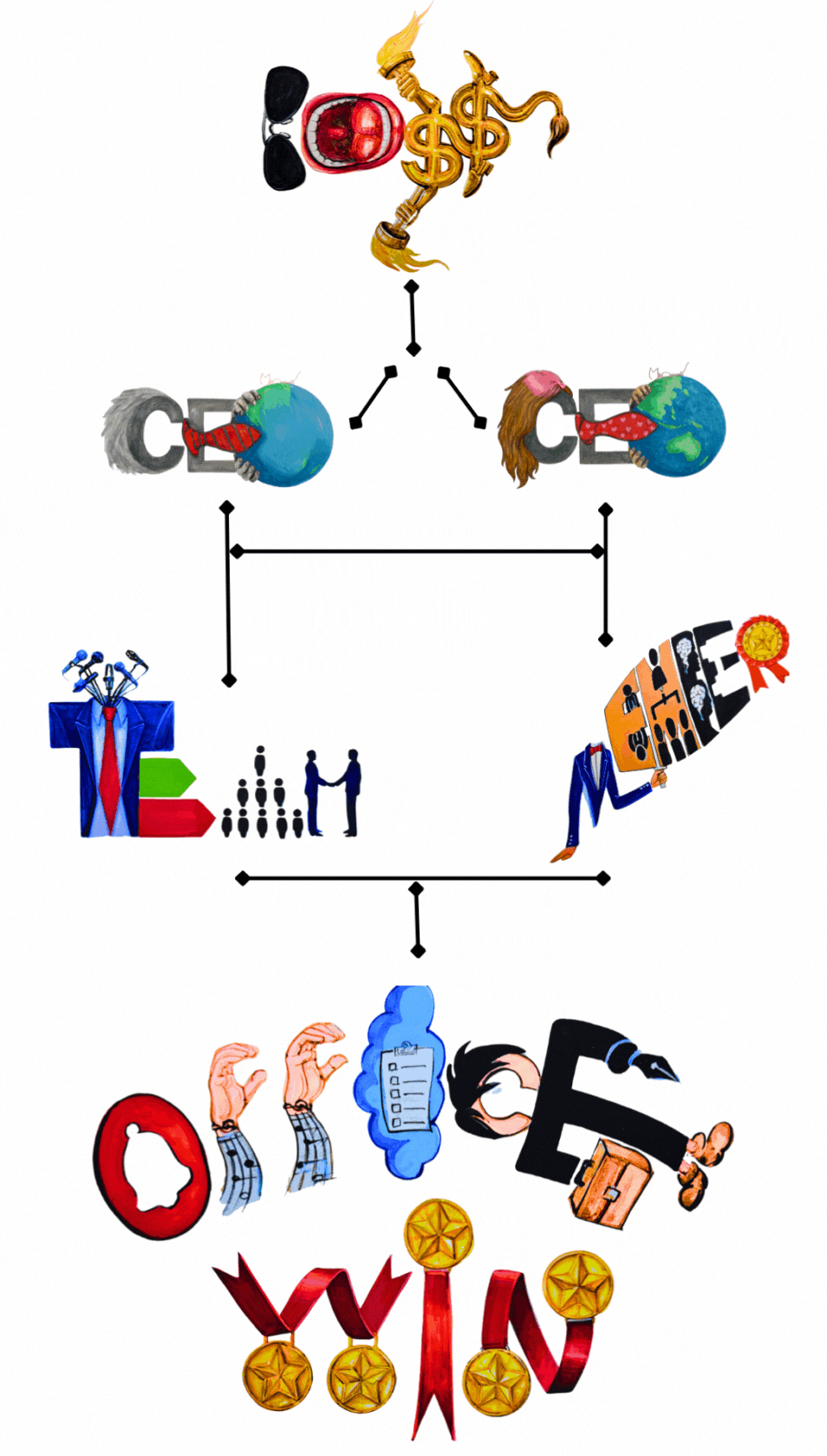
Corporate and MICE events in 2026 — where business meets experience design
Why corporate events now require the same creativity as weddings
Corporate events are no longer only functional. Attendees expect memorable moments that build culture and loyalty. Creativity helps deliver outcomes: better networking, clearer messaging and more meaningful takeaways.
Leadership retreats, summits, incentive travel and brand moments
Each corporate format requires balance: content that delivers business value; experiences that foster connection. The role of design is to integrate both.
Avoiding generic hotel conference formats
Large hotels offer convenience but often produce predictable experiences. We mix those venues with unique local spaces to create more memorable chapters and prevent fatigue.
Managing executives, privacy, agendas and logistics under one system
Corporate events are procurement-sensitive and often require formal reporting. We build procurement logs, risk matrices and stakeholder alignment processes to match corporate governance.

High-complexity & VIP events — planning where failure is not an option
Privacy-sensitive weddings, parties and summits
Confidentiality is operational work. It’s staff vetting, secure briefings, and NDA frameworks. For VIPs, “invisible” service is everything — the fewer visible controls, the higher the comfort.
Security, controlled access, and discreet logistics
Security should not feel security; it should feel seamless. That requires choreography: discrete entry points, private holding rooms, and calibrated staffing that blends hospitality with protection.
Multi-layer guest management and confidential operations
VIP programs often split guests into tiers: private entourages, extended family, and public-facing elements. Each tier gets bespoke flows, controlled media exposure and carefully scripted touchpoints.
Why VIP planning is a discipline, not a price tier
VIP standards are process-driven. They require documented workflows and specialists who can align aviation, shipping, and diplomatic protocols if necessary.

Why technology matters in event planning (but should never replace human judgment)
App-style platforms as planning tools, not marketing gimmicks
Technology helps manage complexity: guest portals, rehearsal logs, and live communication channels. But tech is a tool — it should not craft decisions. The human team must always set strategy and interpret nuance.
Why guest experience begins before arrival
A guest app, digital itinerary, and customised communication create calm before arrival. Small things — dietary confirmations, arrival briefs, and discreet pre-welcome notes — dramatically improve the on-site experience.
Digital structure as a way to reduce chaos, not add complexity
Too many systems create noise. Use a single master source-of-truth for logistics, and keep guests on simple, curated paths.
The danger of over-automation in creative industries
Automation can sap personality. Personal touches — a handwritten note, a local guide’s introduction — are valuable precisely because they are human.

Original art as strategy — why creativity can’t be outsourced
Stock imagery vs original visual language
Stock images are efficient and often forgettable. Original art becomes a motif you can carry from stationery to stage. It’s a unifying thread that makes an event feel singular.
Art as an operational asset, not decoration
An original composition or calligraphy isn’t just pretty: it can guide décor choices, inform menus, and become a motif for branded experiences and gifts.
Why originality builds trust faster than claims
Original work signals investment. When a planner commissions bespoke art, it communicates care, time and a refusal to imitate.
How visual identity affects guest perception subconsciously
Guests do not always name why an event feels “right.” Often the reason is consistent visual language. Cohesion — from signage to music — signals quality.

Why the right enquiry process is the foundation of a successful event
Why serious events begin before the first meeting
The intake is the project’s first design tool. A structured enquiry reveals budget realism, timeline constraints, cultural needs and decision hierarchies. Without it, assumptions multiply.
How structured enquiries protect both clients and planners
A clear intake creates shared expectations. It reduces scope creep and allows early disqualification rather than late disappointment.
Thinking clearly before spending heavily
Spending without a plan is expensive. A well-constructed intake clarifies priorities so that every baht is aligned with what matters most.
Why even declined enquiries still benefit
the client
An honest “no” with useful feedback can save the client money and point them to a better route. Ethical clarity protects reputation.

What 2026 means for clients planning events in Thailand
For couples planning weddings
If you’re planning a wedding in Thailand in 2026, expect a process: research, intake, concept development, procurement, rehearsals, and a production run. Your job is storytelling; ours is making sure the story reaches your guests with clarity and heart.
For families planning milestone celebrations
Milestone events need personal intelligence. We map the timeline so the family can breathe and enjoy, while the team handles complexity.
For corporations planning retreats and summits
Your event should produce measurable outcomes. We design KPIs (attendance, engagement, follow-up value) and build programs that meet them.
For global planners seeking Thailand-based execution partners
If you’re a planner outside Thailand, you can expect a reliable local partner who understands procurement, venue limitations and cultural norms — and who can protect the integrity of your concept.
Siam Planner Co., Ltd. (ThailandPlanner.com) — our event planning philosophy
(This is the extended, blueprint-style manifesto we live by — our practical philosophy for 2026 and beyond.)
Note: this section is intentionally long and detailed. It is our public blueprint: how we believe planning should work, why creativity must be disciplined, and how we measure success. Read it as an operational philosophy rather than promotional copy.
Creativity must be disciplined
Creativity without constraints is decoration; creativity constrained by production realities becomes architecture. We insist every concept begin with constraints: climate, acoustics, neighbor rules, guest mobility, and technical feasibility. Constraints are not limitations — they provide frames that make ideas unique and executable.
Discipline means: testable ideas at every stage, realistic budgets, show-able production plots, and rehearsals. A beautiful concept that cannot be built is a liability. Our creative work begins at the intersection of possibility and meaning.
Research-led design, not template replication
We reject the “copy-and-paste” model. Every client gets research: family histories, cultural briefings, site visits, and when necessary, consultations with cultural practitioners or academics. This is how we avoid surface-level appropriation and deliver ritual integrity.
When a client says “I want a wedding that feels like my hometown,” we do not hand them a Pinterest board. We study that hometown: the rhythm of ceremonies, the musical motifs, the objects that hold meaning. That study informs everything from the timing of rituals to table centers.
Production management as creative instrumentality
Production managers are not gatekeepers of execution; they are co-creators. Technical direction, run-sheets, and show calling are creative instruments that shape guest emotion. Lighting charts don’t just illuminate; they orchestrate focus and silence. Sound plots shape entrance and exit moments. We treat production documents as part of the creative brief.
A practical consequence: we rehearse. Not as an afterthought, but as a deliberate production rehearsal that sits alongside creative sign-offs. In our experience, events that allocate rehearsal time achieve emotional arcs reliably.
Venue selection is curatorship, not shopping
Choosing a venue is intellectual work. We ask: Which place best supports the guest experience? Does the view require shielding at sunset? Do outdoor spaces have night-noise restrictions? What route will guests take from arrival to ceremony?
Venue hunts are research trips. We find tucked cliffs, heritage houses, and lawns with unusual light. The right venue makes the concept easier and more convincing.
Guest profiling and hospitality engineering
Guests are systems, not personas. When given a guest list we parse travel patterns, arrival windows, dietary laws, mobility constraints and emotional expectations. Arrival choreography, quiet spaces for elders, and transitional music moments are not luxuries — they are core hospitality.
Every guest touchpoint — from holding rooms to late-night snacks — is planned so the program feels generous and curated.
Procurement transparency and budget stewardship
We operate on a transparent, percentage-based management fee. We do not hide margins. Our aim: the clearer the budget, the more trust we build. This model aligns incentives: better optimization benefits both client and planner.
We educate clients on where money matters most and where it doesn’t. A brand-name centerpiece can’t replace exceptional cuisine or technical reliability.
Team accountability — one voice, one accountable team
The client should never hear competing opinions from different vendors. Our model creates a single accountable team that speaks with one voice to the client and vendors. This approach reduces friction and speeds decision-making when timelines compress.
Ethics, privacy, and security
We treat privacy as non-negotiable. For VIP clients, we implement NDAs, vetted staff, and secure routing. Ethics also include vendor vetting — we refuse to work with suppliers who cut corners on labor or safety.
Original artistry — investing in human creators
Our studio commissions art, calligraphy, soundtracks and original photography. This investment is not vanity; it provides motifs that travel across a program: stationery, digital touchpoints, stage design, and gifts. Original art becomes the thread that makes an event feel connected.
Contingency & crisis planning
The difference between a recovered disruption and a ruined night can be thirty minutes. We map contingencies, create decision trees, and rehearse hypothetical disruptions. This makes our teams calm, decisive and effective.
Measurement — qualitative and operational KPIs
We measure success not only by applause but by operational data: schedule adherence, incident counts, vendor performance and budget variance. We combine these with qualitative metrics: guest surprise, emotional outcomes, and the client’s sense of relief.
Education & mentorship
We run workshops for local teams, mentor suppliers in production standards, and share post-event debriefs to lift the industry. A stronger local ecosystem benefits everyone.

The five enquiry paths — why each exists and what they capture
Choosing the right intake path routes projects to the right team fast. Each path is practical intelligence, not marketing.
Strategic Event Entry Enquiry — for broad ideas and early-stage clients. Captures intent and routes projects to the correct division.
Destination Wedding Enquiry — captures family structure, rituals, legal timelines and multi-day sequencing.
Private Party & Celebration Enquiry — captures program structure, multi-day preferences and transport.
VIP & High-Complexity Enquiry — captures confidentiality needs, security and private aviation requirements.
Corporate, MICE & Business Enquiry — captures governance, procurement, speaker logistics and reporting needs.
A good intake ensures the right experts read the brief first, not the wrong person.

What happens after you submit an enquiry — the honest version
We manually read every enquiry. Outcomes are pragmatic:
Accepted for follow-up — we invite a consultation and outline next steps.
Advised — we provide practical suggestions or referral if we’re not the best fit.
Declined respectfully — if the project’s scale or timing isn’t right, we explain why.
Transparency at this stage saves time and preserves standards.

Free consultation — what it is and what it isn’t
A free consultation is an expert evaluation: a candid alignment conversation about feasibility and high-level suggestions. It is not a full concept, a detailed budget or a site survey. Those are paid, and for good reason — they require the team’s time, travel and technical resources.
A consultation is the bridge between enquiry and engagement. It tells both sides whether the partnership should continue.

Budget truths everyone should know
Budgets are ecosystems. Bigger budgets often require more governance and longer timelines. Some things scale poorly (logistics complexity grows faster than headcount), others scale well (a great chef scales across plates). Our percentage model reduces with scale; the result is more budget directed into guest experience, not hidden margins.
Understanding where money matters — production vs décor, AV vs florals — comes from experience. We guide clients to invest where it creates lasting memory.

Why this matters even if you use another planner
This article is useful beyond our doors. If you never hire us, you can still use these principles:
Spot red flags in proposals
Protect your guests and budget
Avoid preventable mistakes
Treat the intake as an hour that saves weeks of pain.

Practical checklist — questions you should ask any planner in Thailand
When you speak to a planner, ask:
What is your intake process?
Who will be onsite and what is their experience with local vendors?
How do you handle procurement and transparency?
What is included in your fee and what isn’t?
How do you approach cultural research and family dynamics?
How do you manage guest logistics and transport?
What are your contingency plans?
Answers reveal whether a planner is systematic or improvisational.

Red flags to watch for
Slow down if the planner:
Has no clear intake (only “DM us” or “send screenshots”)
Refuses to discuss budget openly
Uses the same supplier for every brief without vetting
Avoids questions about risk, permits or guest logistics
Is vague about fees and margins
If you see these, re-evaluate.

Case example: why intake mattered (short story)
A “birthday dinner” enquiry revealed multiple VIPs arriving on private aircraft and strict privacy needs. Because the intake captured that, we restructured the brief into a private program: secure arrivals, layered guest flows, and multiple private spaces. Without that intake the event would have been scheduled as a single dinner and failed on arrival.

Measuring success — qualitative metrics and operational reports
We combine guest feedback with operational KPIs: schedule adherence, incident counts, vendor performance, and budget variance. Post-event reports consolidate learnings and preserve institutional memory. This makes future programs better and builds trust.

Post-event stewardship — how experiences become legacies
Our relationship rarely ends with the last song. We deliver reports, return key items, and advise on storytelling and archives so that the event’s memory becomes legacy — not just an album.

The disrespect of pretending to be unique — why forms matter
Claiming uniqueness while accepting casual enquiries is disingenuous. Forms are not red tape; they are a promise of careful attention. Asking the right questions is a sign of respect.

Closing the loop — authorship, accountability and long-term relationships
A planner should be a mastermind: curious, disciplined, negotiators, creative and capable of saying “this is not the right fit.” When these elements combine, a project becomes authored, not assembled. That is our aim.

A new standard quietly took shape in Thailand in 2026
As 2026 begins, the industry is at a crossroads. The people who combine art, discipline, and accountable systems will be the teams trusted for high-stakes work. If you plan to bring guests to Thailand this year with serious intent, start with clarity: a structured enquiry, a thoughtful consultation, and a team that treats originality as responsibility.

Our complete structural guides: Thailand Wedding Planning Manual, High-End Private Party Manual, and Corporate Event & MICE Strategy in Thailand.
If you’re planning an Indian wedding or multi-day destination celebration in Thailand, our full Indian Wedding planning overview is available here.
To begin with a focused consultation and structured fit assessment, submit a Wedding, Private Celebration, or Corporate / MICE enquiry form.


